Wednesday, 3 May 2017


HELEN II LOOKING GOOD.
Today Shipwright Dave worked on the cabin top grab rails.Each one is made from a length of teak.
The supports are measured and placed over the cabin beams . They can then be bolted through the beams to give extra strength.
(click on the picture to view the detail )

He also finished off the corners of the cabin from blocks of teak (left) glued and screwed into place before being sanded down .(right)
 It looks beautiful !

Wednesday Phil , ignoring the agony of tennis elbow and no sugar for the tea, continued sanding down the hull below the water line to remove excess red lead putty.This created a smooth hull fit to glide through the water.
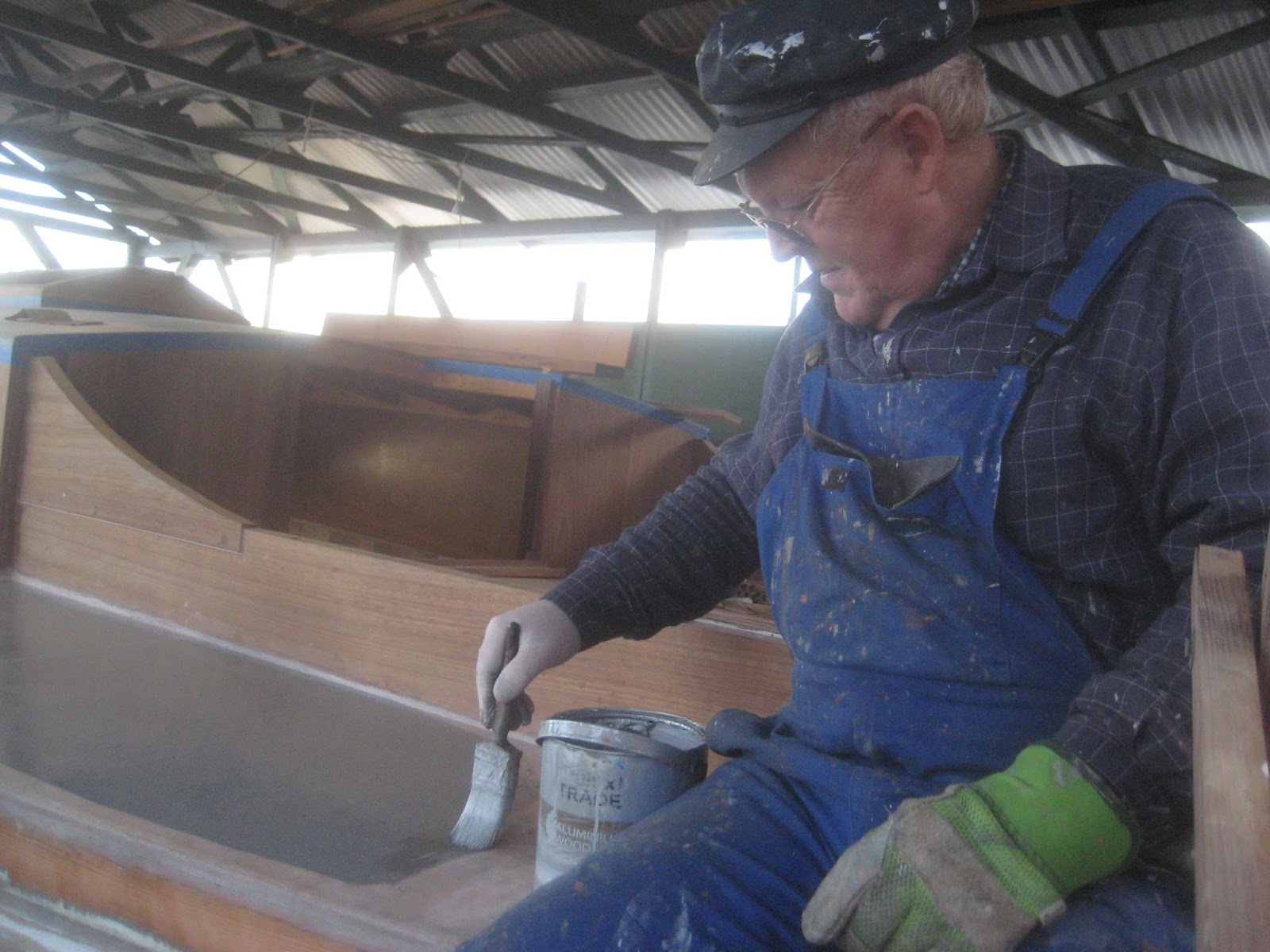
This was painted with aluminium primer thinned as a first coat.
"Next time," said Dave ,"you can give it another good layer of undercoat !"
"Oh goodie !"said Wednesday Phil as he chewed on another paracetamol........


Phil then emptied the donations buoy .
Shipwright Dave and Phil are always surprised at the generosity of the visitors to our compound.
Thanks to all who donate to Helen II.


 And finally..... the oak beams to create the rudder were delivered by Adrian from his Elwy Wood saw mill.He is a great supporter of the project .

Sunday, 30 April 2017


An update of progress...........

In the last month quite a bit has happened.
The lads had a week off and Apprentice Dave left the project to take up a job up the Conwy valley  leaving shipwright Dave home alone ! 
Dave has patterned the keel band which is a strip of metal bolted on to the underside of the  keel.This will protect the wooden keel from damage if it should ever sit on nasty rocks or uneven ground.Once welded and " first fitted " it will be sent away for galvanizing before being  permanently fixed on.
Dave then fitted the stem head  .This is a large chunk of wood bolted to the bow in which the anchor chain sits when anchored up .
To the front of this is bolted a metal plate for protection and strength.


A local engineer is making the chain plates for the side of the hull. These are metal strips that will hold up the rigging.
As Wednesday Phil is still on light duties, lifting heavy objects is not allowed, which  makes Dave short handed at times.
 So Phil continues sanding down the hull to smooth out the caulking putty and then painting the planking with aluminium primer.


 Within the hull, the floors (planks) were removed  so that Dave could fit a final keel bolt and so Phil gave the bilges (the space below the floors) another coat of red oxide for extra protection.
Notice the artistic finish below !


Dave is now finishing the entry hatch and cabin rubbing band.
The jobs presently  are more detailed and time consuming, especially when Dave is working alone.
 

Thursday, 9 March 2017


THE CAULKING IS COMPLETED  AND MURRAY  SHOWS ANOTHER SKILL !

As Wednesday Phil has been on an all expenses denied observation of boat building  in Tenerife, the Daves have continued caulking and filling over this with red lead putty mix.. The hull is now waterproof except for the prop shaft (which drives the propeller) hole  through the hull.

The metal frame to hold the rudder has returned after being galvanised.
And a local metal worker from Penmaenmawr has been to make patterns for the fittings to support the rigging.

 Today Shipwright Dave finalised the keel boats which hold the heavy ballast casting (big lump of cast iron) to the keel .This stops it moving inside the hull during rough weather .

Wednesday Phil   and Dave managed to move the engine to the side of the hull to allow the floor to be lifted to finish the bolts.

 
Then Murray ,one of the trustees, arrived to continue carving the name plates for the boat. 
One of his hobbies is carving detailed and intricate designs.


This attracted many observers who were keen to see the methods employed.


Wednesday Phil was fascinated to see the many processes employed to sharpen his tools to a razor sharp condition.


Murray sadly declined my invitation to carve a sign for

Llanfairpwllgwyngyllgogerychwyrndrobwllllantysilioogogogoch.
Still - I'm optimistic !

Thursday, 2 February 2017


THE WORK CONTINUES AND A LEVEL AROUND THE BOAT IS FOUND.
Work continues apace to make the boat water tight.
Both Daves have taken over caulking the planks since Wednesday Phil tore muscles limbo dancing under the hull with his caulking hammer.
Apprentice Dave fairs in the stern post to the planks to create a streamline hull. 

 Shipwright Dave has drilled a hole into the rudder tube and added a small tube to allow grease to be pumped into the rudder tube to keep it movable. (click on the picture to see in detail )


Dave then prepares to seal down the cover to make the area water tight. 


FINDING A LEVEL ANYWHERE ON  THE HULL.
 To my fascination Shipwright Dave appeared with a long clear tube which he began to fill with water.
When I asked him what he was going to do with that ,I was relieved to hear he was going to use it to find a level around the boat.
 Here's how it works.....
If you mark a point on the hull ,you can find a level anywhere on the other side of the hull.
If you pass the tube under the keel and hold the tube up on the other side ,you can raise and lower it until the water level in the tube is lying alongside the  mark you made..
Once the water settles, the opposite end of the tube will show the point on the hull that is level with it.
That is because water always levels out in a tube.
 (hope this can be understood ! )
 So I learned another clever method ! 


The result is a level line around the boat. 

Wednesday, 11 January 2017


AFTER THE CHRISTMAS HOLIDAYS ITS UPDATE TIME

Over the past few weeks since the last blog, Apprentice Dave has finished the forward hatch and is now perfecting his christmas present for his daughter  "Jack In A Box"


Then he completed the flooring in the forward bunk section and moved on to make slats in the wet store.


This will allow air to circulate around clothing to reduce any condensation and speed up drying.

Wednesday Phil continued painting the decks and glossing internal woodwork.
 He is now on light  duties as muscle tears and tendon inflammation, due to repetative strain, is reminding him that he's no longer a young whipersnapper and he has to ham it up to win a compensation claim !


Shipwright Dave continued  making and fitting toe rails on to the deck to prevent crew sliding off the boat in slippy times.
Once first  fitted  (making sure all fits correctly) they are bent into place using brute force ( called Dave) and sealed with mastic sealant.


As the toe rail has to be made of five sections ,each plank has to be joined to the previous one by  a scarf joint.
Dave does this by  cutting both ends into a wedge  which marry up exactly as in the picture.( click on the picture to see the detail )
These are then clamped together with a mastic  core and bolted together for a rigid joint. It's a joy to see the precision !

In order to make the stern section, thin planks of wood had to be steamed, bent and glued together around a template which is an exact copy of the required shape.
Dave made the template from plywood and five layers of wood were bent and glued together to form the lamination.
This fitted perfectly to the stern and was scarfed in.
Shipwright Dave looked on with satisfaction ( as an artist might view a picture ).
We all knew he was some kind of artist !
Today's final photos of the completed toe rail.


Apprentice Dave begins work on the cabin hatch................
to be continued !


Wednesday, 7 December 2016


LLANDRILLO SENDS ITS "A" TEAM TO HELP.

The team of students who visited last week were really keen and had a good commitment 


Today's group showed similar values but
they took to the task of puttying instantly and thus Wednesday Phil was aghast at the speed of their expertise ! No naughty corner for these lads.
Joshua,Cory,Alex and tutor Fraser worked with little supervision and were heard advising each other on technique.
If you click on the picture you can see how Cory works the putty leaving a raised profile.

Apprentice Dave created a template in ply for the flooring in the bow section of the boat. This is then transferred to a plank of larch to be fitted tomorrow.
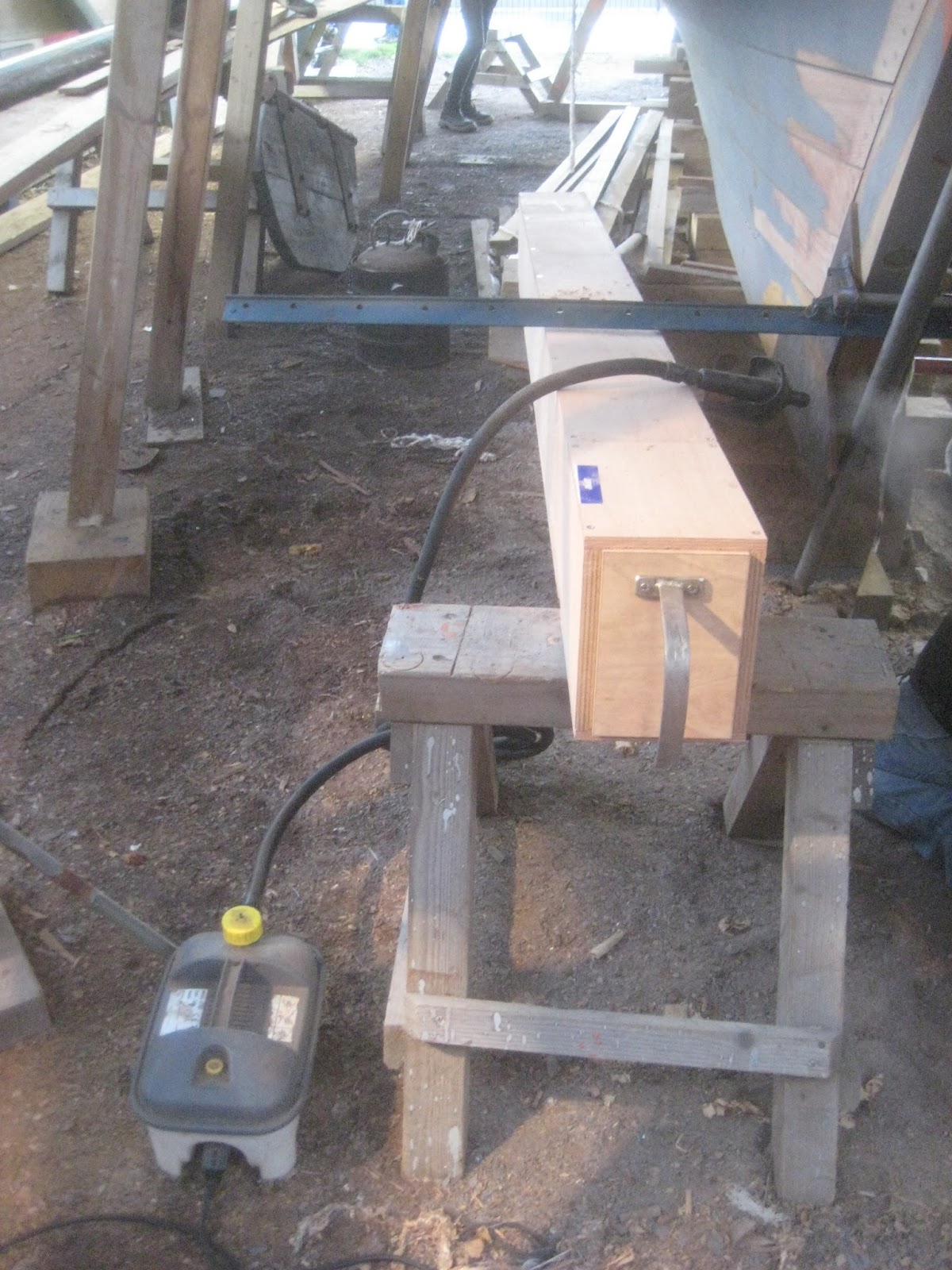
Shipwright Dave created a steam box in ply, to be powered by a wallpaper steamer.
The rule of thumb is to steam wood for an hour per inch thickness of planking.
He decided to see how it would work on a test plank for the stern approximately half an inch thick.Thus once up to steam, the plank was inserted in the steamer for half an hour.


Then, with clamps and many hands,the plank was fitted while still hot.
We were all pleased to see how successful this plank fitting proved. I was surprised how supple wood becomes after such a short time.
I tend to over cook mine by hours !
This is the first steaming we have had to do on the boat.

Monday, 5 December 2016


LLANDRILLO  STUDENS ARRIVE TO HELP AND LEARN
Kyle,Ethan,Gary,Sally ,Rory and tutor Frazer arrived today for three days of hard work.

 After rigging the safety net, tutor Fraser dived in to test it's effectiveness. and re enact a scene from Romeo and Juliet with stand in Dave trying to look coy.


After solving the problem of creating a raised mound of putty between the planks, Wednesday Phil showed the students the technique and they began learning by experience.

Kyle  worked independently

while Ethan and Gary teamed up, after having made Wednesday Phil comfortable in his arm chair.The concentration was a joy to behold !

 
Rory began making deck hoops to fit around the mast  to make the mast  water tight at deck level while Sally continued caulking .


Shipwright Dave began fixing the toe rail along the starboard (right ) edge of the deck. This is designed to stop people slipping off the deck during drunken sea shanties.
(Well that's what I think.)